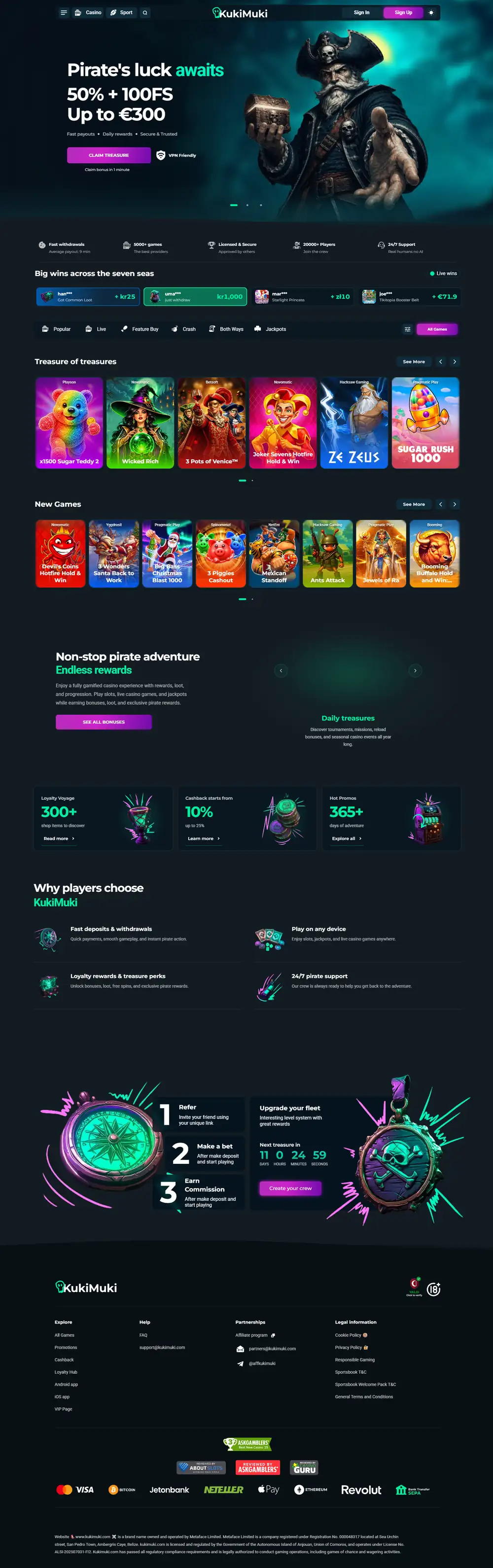
At Databank I work on KukiMuki's account, cashier, promotions and loyalty features. The same frontend team maintains ZenCasino in a separate repository, so feature changes need to be adapted to each brand.
The challenge
Payment, bonus and account data arrive independently. The interface must coordinate these updates, make loading and failure states clear, and handle real-time loyalty updates without duplicate connections or claims.
Scope and approach
Product scope
Registration, account settings, identity verification, deposits and withdrawals.
CMS promotions, daily missions, loyalty calendars and animated game interfaces.
Technical approach
NgRx holds shared feature state; RxJS coordinates asynchronous work and Signals express derived UI state.
Feature orchestrators coordinate cashier and bonus rules outside components. I extended the pattern to the support, referral and bundle features.
TransferState reuses server-fetched CMS content during hydration. Brand configuration and releases remain separate for KukiMuki and ZenCasino.
What I did
01Developed Angular account and payment flows with Reactive Forms, NgRx, PaymentIQ and Sumsub; extracted cashier and bonus coordination into reusable orchestrators.
02Implemented daily missions, loyalty-calendar claims and CMS-driven Welcome Pack banners with explicit loading, empty and failure states.
03Reused SSR-fetched promotions through TransferState and RxJS caching; reworked live-win loading, animation scheduling and cleanup.
04Used Lighthouse and Clarity to investigate banner and page loading on slow connections; configured Sentry tracing/profiling and implemented technical SEO for public pages.
05Fixed backend-driven payment validation, autofill and cashier readiness; coordinated corresponding feature updates in ZenCasino.
Engineering examples
Seven problems, how I solved them, and what changed.
Cashier state outside UI components
Problem
Payment selection, bonus rules and validation were spread across components, while independent requests made readiness hard to express.
Implementation
Introduced CashierOrchestrator, then added payment/bonus readiness signals, a combined loader and a failure path that ends loading without treating an error as success.
Result
Components consume coordinated feature state, and failed requests no longer leave the cashier waiting indefinitely.
CMS data reuse after SSR
Problem
The browser could repeat a promotional-content request already made during server rendering.
Implementation
Stored the CMS response in TransferState and consumed it during browser initialization. Used shareReplay for later subscribers, with a normal request when no transferred data exists.
Result
When SSR data is available, hydration reuses that response instead of requesting the same promotional content again.
Live-win carousel loading and cleanup
Problem
The carousel combined API requests, a win queue and animation callbacks that could outlive the component.
Implementation
Reworked idle loading, guarded concurrent fetches and limited refetching to once per 60 seconds. Started sliding only when data was ready, cancelled animation frames on teardown and retained the last successful response as fallback.
Result
Fetching and animation follow the same lifecycle, with explicit handling for empty queues, API failure and component destruction.
Parsing backend validation rules
Problem
Payment patterns arrived with regex delimiters and flags; removing every tilde did not parse the format correctly.
Implementation
Added delimiter and escaped-delimiter parsing, supported JavaScript flags and a fallback for unparseable rules before creating Angular validators.
Result
Dynamic fields apply the supplied pattern and flags through a defined parsing path.
Welcome Pack loading and empty states
Problem
CMS banners could resolve welcome offers differently or keep waiting when no eligible pack existed.
Implementation
Extracted shared first-deposit pack selection, active-bonus priority and percentage/free-spin formatting, with explicit loading and resolved states.
Result
Banners use one presentation model, and the no-pack path completes instead of remaining in a loading state.
Retrying missions for the same user
Problem
User-ID deduplication suppressed retries after a failed missions connection when the user had not changed.
Implementation
Allowed repeated user IDs to trigger a retry while retaining the service guard for active or pending connections. Combined the missions snapshot and Socket.IO progress updates through NgRx.
Result
A failed connection can retry for the same user without bypassing the guard against duplicate active connections.
Calendar claims and workflow failures
Problem
Reward claims needed per-item loading and protection against parallel requests. A failed backend workflow could resemble an empty calendar.
Implementation
Added promotion-scoped loading, claim guards, finalize cleanup and refresh after success. Represented workflow failure explicitly and disabled premium fallback data on that path.
Result
Claims have a defined lifecycle, and backend workflow failure is distinct from an empty reward list.
Cashier and loyalty features now handle loading, failures and retries explicitly. Promotional content is reused after SSR, and animation work is coordinated with data loading and component teardown.