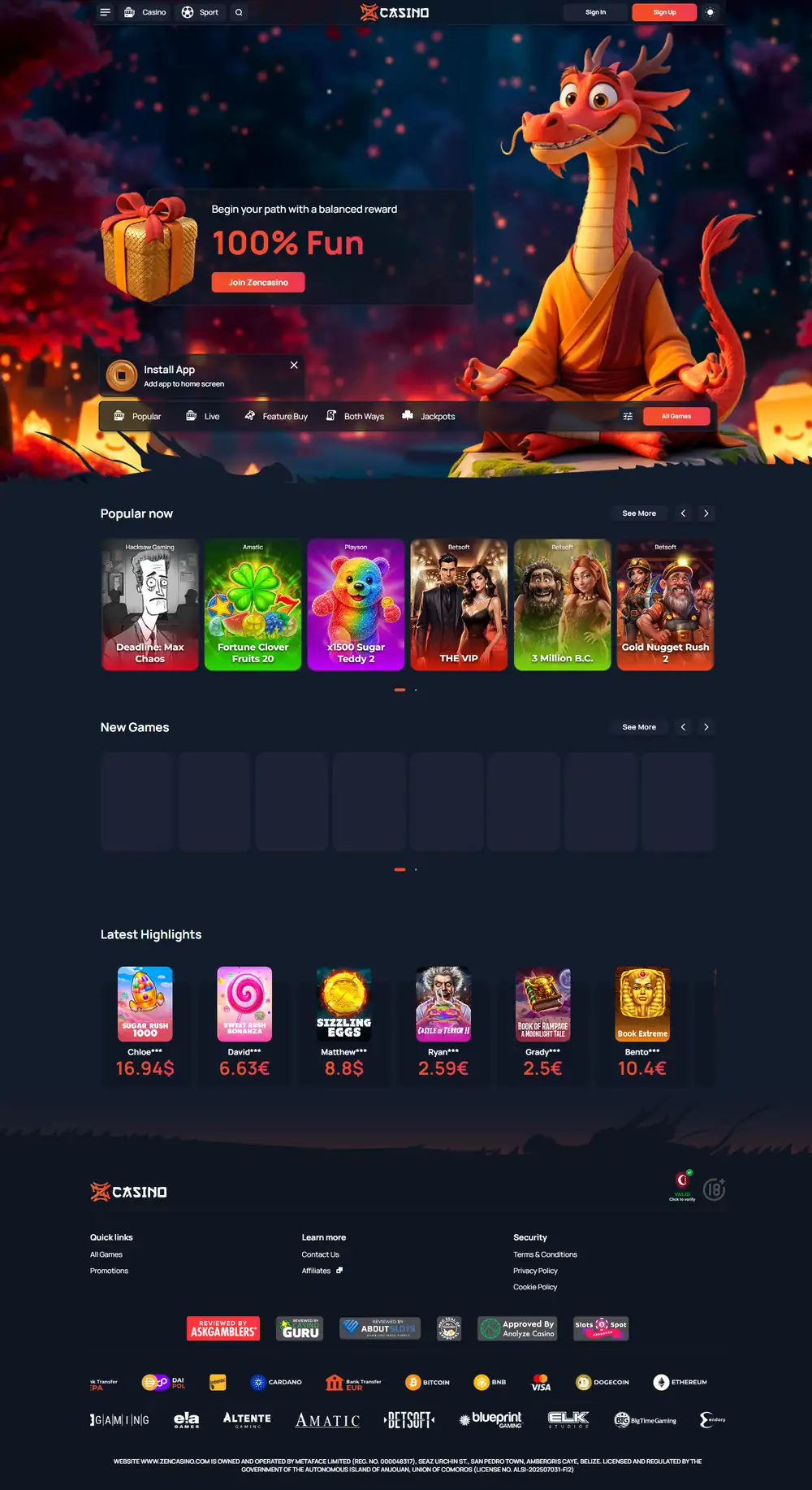
Live Angular iGaming product. Work on registration, payment validation and SSR promotion pages, including form-state preservation during asynchronous updates.
I develop account, cashier and promotion features for ZenCasino at Databank. It shares feature patterns with KukiMuki but has its own repository, theme and configuration. This case focuses on form behavior and API integration.
The challenge
Forms must accept typed, pasted, autofilled and saved payment details consistently. Asynchronous defaults and dynamic form updates must preserve what the user has already entered.
Scope and approach
Product scope
Registration, account and cashier interfaces adapted to the ZenCasino brand.
Payment-method selection, bank-detail entry and CMS promotion pages.
Technical approach
Normalize payment values at each input path and keep displayed text aligned with Reactive Forms state.
Apply registration defaults only to empty, untouched fields and carry current values into rebuilt controls.
Handle promotion route changes in the browser, while allowing SSR to complete with a valid page or an HTTP 404.
What I did
01Adapted account, cashier and promotion flows to ZenCasino's theme, configuration and API responses.
02Normalized IBAN entry across typing, paste, autofill and saved values; preserved registration input during dynamic control rebuilds.
03Separated deposit and withdrawal currency selection and normalized payment IDs from different API response shapes.
04Implemented route-driven promotion loading, SSR completion, metadata and missing-page handling; worked on loading performance and public-page indexing.
Engineering examples
Four problems, how I solved them, and what changed.
Consistent IBAN input
Problem
Spaces in copied IBANs caused validation failures, and typing, paste, autofill and saved values updated the form differently.
Implementation
Normalized spaces and separators across input paths, synchronized the DOM value with FormControl and preserved cursor position during editing.
Result
All supported input paths produce consistent displayed text and Angular form state before a withdrawal request.
Preserving registration input
Problem
Asynchronous defaults and dynamic control rebuilds could overwrite values the user had already entered.
Implementation
Carried current values into rebuilt controls and applied country/currency defaults only to empty controls that were neither dirty nor touched.
Result
Rebuilding the form preserves entered values and leaves defaults for empty, untouched fields.
Promotion routes in the browser and on the server
Problem
Promotion pages needed to respond to browser route changes and finish SSR, including when a slug did not exist.
Implementation
Used switchMap for route-driven loading, client lifecycle cleanup and a single-emission SSR path. Adapted metadata and HTTP 404 handling.
Result
Client navigation loads the selected promotion, while SSR completes with the page or a defined not-found response.
Saved payment selection by operation
Problem
Deposit and withdrawal responses used different currency fields and returned payment IDs as scalars or nested objects.
Implementation
Separated deposit/withdrawal currency selection and normalized supported ID shapes to strings before comparing methods.
Result
Saved-method selection follows each operation's API contract instead of assuming identical response shapes.
Registration retains entered values during asynchronous updates. Payment fields and saved-method selection follow consistent form and API rules, and promotion routes return defined SSR and not-found responses.